MD
PDFtoMarkdown
Scientific & STEM

Convert PDF Math Formulas to LaTeX Markdown

Extract calculus equations, Greek symbols, matrices, and scientific notation from PDFs into clean, KaTeX-ready Markdown delimiters.

100% In-Browser Private
6 min read
Updated September 2026

LaTeX & Math Extraction Engine

100% In-Browser Conversion — Your Files Are Never Uploaded

Drag & Drop your PDF document here

or browse files on your device

⚡ No file size limit 🔒 100% Private
Markdown Output
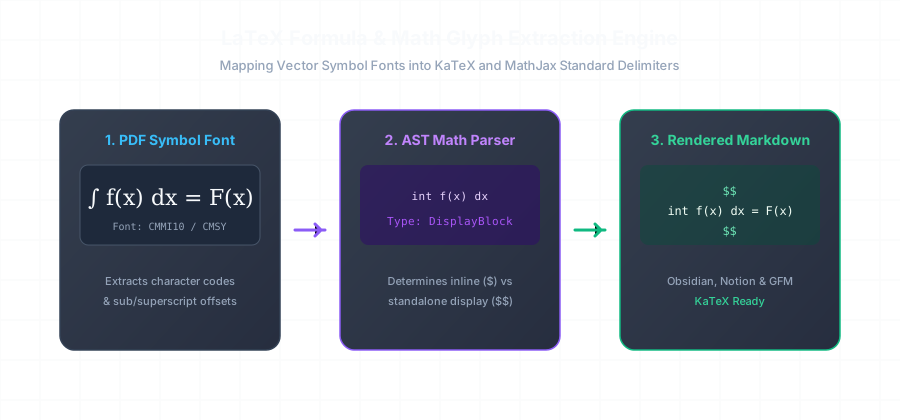
LaTeX Formula and Math Glyph Extraction Pipeline Diagram

Before vs. After: From Broken PDF Glyphs to Valid LaTeX

Scientific PDFs use custom font encodings that produce corrupted text when copied. Our parser maps glyphs back to clean LaTeX commands:

Raw PDF Clipboard (Mangled Math)
Broken Layout
∫_0^∞ e^(-x^2) dx = √π / 2
E = mc^2
f(x) = ∑_{n=0}^∞ (f^(n)(a)/n!) (x-a)^n
Output LaTeX Markdown ($ and $$ Delimiters)
Valid CommonMark
The Gaussian integral is defined as:

$$
\int_{0}^{\infty} e^{-x^2} \, dx = \frac{\sqrt{\pi}}{2}
$$

According to mass-energy equivalence, $E = mc^2$. The Taylor series expansion around $x = a$ is:

$$
f(x) = \sum_{n=0}^{\infty} \frac{f^{(n)}(a)}{n!} (x - a)^n
$$

The Challenge with PDF Mathematical Typography

In modern scientific publishing (such as arXiv, IEEE, Springer, and ACM), mathematical papers are compiled from LaTeX source into PDF via engines like pdfTeX or XeTeX. During this compilation, high-level LaTeX macros (\int, \frac, \sqrt) are stripped and replaced with individual vector glyph positioning commands.

When you attempt to copy an equation from a PDF viewer, you get broken unicode or empty squares because the glyph mappings point to private Unicode user areas.

Supported Math Syntax & Ecosystem Compatibility

Inline Equations

Wrapped in single dollar signs $x = \frac{-b \pm \sqrt{b^2 - 4ac}}{2a}$ for seamless inline prose integration.

Display Block Formulas

Centered equation blocks wrapped in double dollar signs $$ ... $$ for major theorems, proofs, and matrices.

Frequently Asked Questions

Everything you need to know about format extraction, privacy, and markdown compatibility.

How does the converter identify mathematical equations inside a PDF?

The engine scans PDF font descriptor dictionaries for TeX math font families (such as Computer Modern, AMS Euler, CMMI, and CMSY). When characters are rendered using these specialized glyph tables, the parser translates raw character codes into standardized LaTeX macros (like \sum, \int, \frac) instead of raw unrendered unicode symbols.

What is the difference between inline and display math in Markdown?

Inline math is embedded directly within a text sentence wrapped in single dollar signs ($E = mc^2$). Display math represents standalone centered equation blocks wrapped in double dollar signs ($$ ... $$). Our parser measures vertical line spacing and text centering to automatically choose the correct delimiter.

Are the extracted formulas compatible with Obsidian, Notion, and GitHub?

Yes. All extracted math uses standard KaTeX and MathJax syntax, which is natively supported out-of-the-box by Obsidian, Notion, GitHub Markdown, and static site generators like Astro, Hugo, and Docusaurus.

Can it extract matrices, summations, and Greek symbols accurately?

Yes. The spatial AST engine tracks vertical stacking to construct LaTeX \frac{numerator}{denominator} fractions, \sum_{lower}^{upper} boundaries, and nested matrix environments like \begin{pmatrix} ... \end{pmatrix}.

Related Conversion Guides & Workflows

Explore dedicated documentation for other document formats and developer pipelines.