Optimizing Chunk Sizes & Overlap for Markdown Documents
When working with structured Markdown in vector retrieval architectures, we recommend:
Eliminate severed tables and fragmented sentences by converting PDFs to Markdown before splitting and embedding into vector databases.
100% In-Browser Conversion — Your Files Are Never Uploaded
Drag & Drop your PDF document here
or browse files on your device
See how arbitrary character splitting breaks table rows versus clean, self-contained Markdown chunks:
# Arbitrary 500-Character Fixed Chunk (Table Severed Mid-Row)
Chunk 1: "...Revenue for the Enterprise segment reached $42.5M while Mid-Market achieved $18.2M.
| Segment | Q1 2025 | Q2 2025 |
| Enterprise | $42.5M |"

Chunk 2: "$58.1M |
| Mid-Market | $18.2M | $24.5M |
Total revenue expanded by 34% across all regions..."# Semantic Markdown Header Chunk (Intact Context & Self-Contained Matrix)
Chunk ID: doc_chunk_04
Header Lineage: [Q1 Financial Results > Revenue by Segment]
Content:
"""
### Revenue by Segment
| Segment | Q1 2025 | Q2 2025 | YoY Growth |
| :--------- | ------: | ------: | ---------: |
| Enterprise | $42.5M | $58.1M | +36.7% |
| Mid-Market | $18.2M | $24.5M | +34.6% |
| Total ARR | $60.7M | $82.6M | +36.1% |
*Note: Enterprise growth was driven by 45 new Fortune 500 subscriptions.*
"""When working with structured Markdown in vector retrieval architectures, we recommend:
Everything you need to know about format extraction, privacy, and markdown compatibility.
Fixed-size chunking (e.g., slicing every 500 characters blindly) frequently cuts sentences in half and splits table rows across separate vectors. When a user asks a question about the table, the embedding similarity score fails because neither chunk contains the full context of column headers and row values.
Semantic chunking splits documents at logical header boundaries (`#`, `##`, `###`). It attaches the full parent header path to the metadata of each chunk, guaranteeing that every retrieved vector retains complete topical context.
In our pipeline, GFM pipe tables are identified as atomic blocks. Semantic splitters are instructed to treat tables as indivisible units, ensuring the header row and all child data rows remain inside a single vector.
All modern vector databases—including Pinecone, Qdrant, Milvus, Weaviate, Chroma, and pgvector—benefit immensely from Markdown chunking due to higher cosine similarity scores and reduced vector count per document.
Explore dedicated documentation for other document formats and developer pipelines.
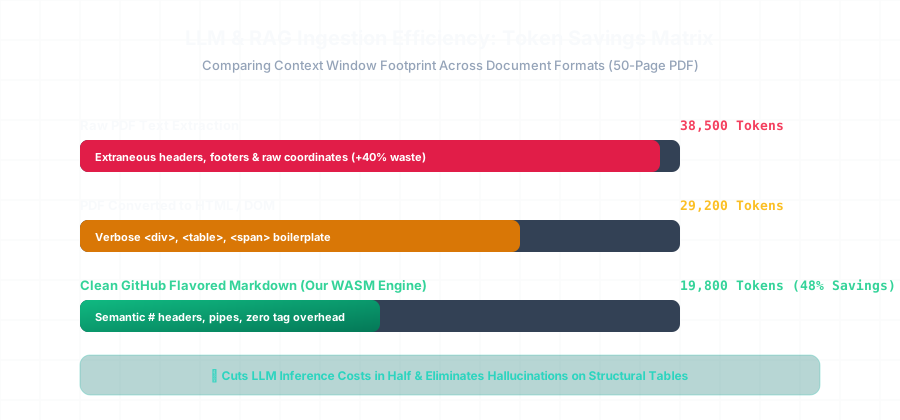
Learn how Markdown reduces prompt tokens by up to 48%.
Implement MarkdownHeaderTextSplitter in Python.
Compare recursive character, sliding window, and semantic header chunking.