MD
PDFtoMarkdown
State of the Industry Report

The State of PDF Parsing in 2026

An architectural analysis of deterministic 2D spatial WebAssembly engines versus cloud Vision-Language Models for modern enterprise AI and document workflows.

100% In-Browser Private
8 min read
Updated September 2026

Experience Modern 2026 WebAssembly Parsing

100% In-Browser Conversion — Your Files Are Never Uploaded

Drag & Drop your PDF document here

or browse files on your device

⚡ No file size limit 🔒 100% Private
Markdown Output
Evolution of PDF Parsing Architecture Timeline and Pipeline Diagram

The Four Eras of PDF Document Extraction

  1. Era 1: Linear Regex & Poppler Wrappers (1993–2015): Basic tools (pdftotext, pypdf) extracted raw glyph streams linearly, completely failing on multi-column layouts and tables.
  2. Era 2: Heuristic Layout Analysis & Python Toolkits (2015–2022): Packages like pdfplumber and LayoutLM introduced bounding-box heuristics, but suffered from slow Python execution and fragile edge-case tuning.
  3. Era 3: Cloud Vision-Language Models (2023–2025): Multimodal LLMs (LlamaParse, ColPali, GPT-4V) parsed visual screenshots of pages. While capable on complex layouts, they introduced \$30–\$100/10k page costs, privacy liabilities, and hallucinations.
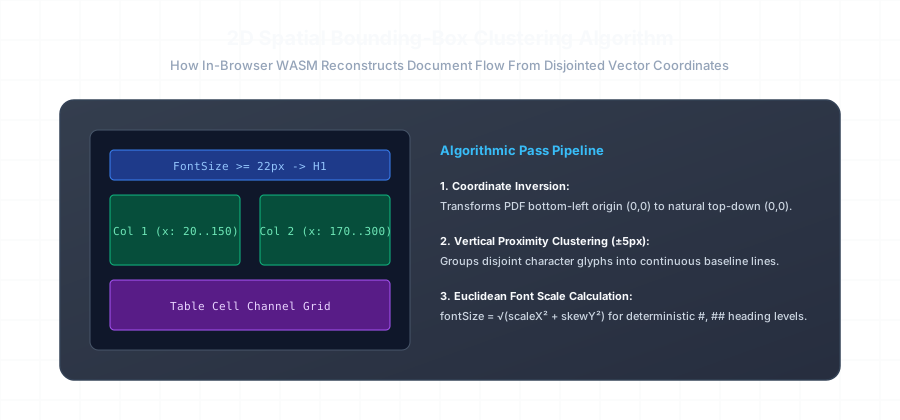
  4. Era 4: Client-Side Spatial WebAssembly (2026+): Native compiled Rust/WASM engines execute deterministic 2D spatial coordinate algorithms directly inside edge workers and client browsers—delivering zero cost, sub-second latency, and absolute privacy.

Frequently Asked Questions

Everything you need to know about format extraction, privacy, and markdown compatibility.

What are the major technological shifts in PDF parsing in 2026?

In 2026, the industry has bifurcated between two paradigms: expensive cloud-based Vision-Language Models (VLMs) for messy hand-drawn diagrams, and lightweight, deterministic client-side WebAssembly (WASM) spatial AST engines for digital documents. Engineering teams are standardizing on WASM spatial engines for 95% of document workloads due to zero cost, sub-second latency, and complete privacy compliance.

Why hasn't AI completely replaced deterministic PDF parsers?

Vision-language models suffer from three major handicaps: high inference cost ($0.003–$0.01 per page), slow throughput (2–6 seconds per page), and non-deterministic hallucination on financial numbers and table boundaries. Deterministic 2D spatial AST parsers calculate exact geometric vector intersections, guaranteeing 100% mathematical accuracy with zero API bills.

How does WebAssembly SIMD accelerate client-side document processing?

WebAssembly SIMD (Single Instruction, Multiple Data) allows modern web browsers to execute parallel vector operations across character bounding boxes, accelerating layout segmentation and OCR neural inference by up to 4x compared to traditional JavaScript.

What is the future outlook for Markdown in enterprise RAG systems?

CommonMark and GitHub Flavored Markdown have established themselves as the universal lingua franca for enterprise LLM context windows, replacing bloated HTML and ambiguous raw text across production AI architectures.

Related Conversion Guides & Workflows

Explore dedicated documentation for other document formats and developer pipelines.